How much does it cost to buy property in Spain: all buyer expenses
The price of property in Spain is not the only amount that needs to be considered when making a purchase. In addition to the cost of an apartment or house, buyers must account for taxes, transaction fees and, in some cases, professional services or bank charges.
The final amount depends on the type of property, its price, the region and the method of payment. That is why it is important to calculate not only the property’s price but also the total transaction budget before making a purchase.
What Makes Up the Cost of Buying Property in Spain
The total cost of buying property in Spain usually includes several main categories of expenses:
– the price of the property itself
– taxes on the purchase
– notary fees
– property registration fees
– legal assistance, if the buyer uses such services
– additional costs related to a mortgage or the specific circumstances of the transaction
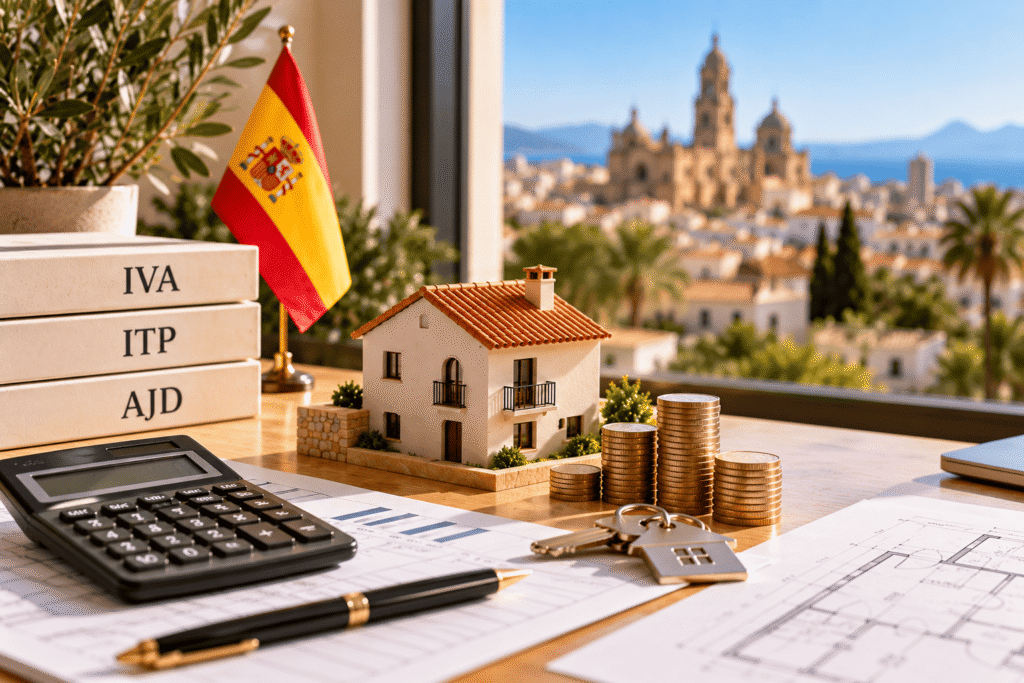
The main difference depends on the type of property. When buying a newly built home directly from a developer, IVA is usually payable, while ITP generally applies to the purchase of a resale property. Tax rates and certain expenses may vary depending on the region and the terms of the transaction.
Taxes on Buying Property in Spain
Taxes are one of the most significant components of a buyer’s additional expenses.
The main tax depends on whether you are buying a newly built property from a developer or a resale property.
IVA on New-Build Properties
When purchasing a newly built property directly from a developer, IVA — Impuesto sobre el Valor Añadido, the Spanish value-added tax, generally applies.
The standard IVA rate for residential property is 10%. Reduced rates may apply to certain categories of social housing.
For example, if an apartment costs €200,000, IVA at a rate of 10% will amount to €20,000.
Thus, the cost of the apartment, including this tax, will be €220,000 — before accounting for other expenses.
It is important to note that the tax treatment depends on the nature of the transaction. Not every property that appears to be new is automatically subject to IVA: the circumstances of the transfer of ownership are what matter.
ITP on Resale Properties
When purchasing a resale property, ITP — Impuesto sobre Transmisiones Patrimoniales, the property transfer tax, generally applies.
Unlike IVA, the ITP rate depends on the autonomous community in which the property is located. In certain cases, reduced rates may be available if specific conditions are met.
Therefore, when buying an apartment in Alicante, Madrid or Barcelona, the amount of tax may differ even if the property prices are identical.
For a preliminary calculation, you need to check the current rate in the specific region where the property is located.
AJD — Tax on Documented Legal Acts
AJD — Actos Jurídicos Documentados is a tax associated with certain notarized documents.
When purchasing a new-build property, AJD may apply in addition to IVA. Its rate depends on the autonomous community and the specific transaction.
When purchasing a resale property subject to ITP, the AJD tax treatment differs from that of a new-build property. Therefore, the same AJD rate cannot automatically be added to every transaction.
Additional Costs When Buying Property
In addition to taxes, buyers need to account for the costs of completing the transaction.
The amount depends on the property’s price, the complexity of the paperwork and the services selected.
Notary Fees
A notary prepares the documents required to complete the property sale and purchase.
Notary fees depend on the established tariffs and the specific circumstances of the transaction.
When calculating your budget, it is worth clarifying in advance which notary fees are payable by the buyer and what conditions have been agreed upon by the parties.
Property Registration
After the transaction is completed, ownership is registered in the Registro de la Propiedad — the Spanish property registry.
Registration fees depend on the characteristics of the transaction and the property’s value.
This expense should be accounted for separately from taxes and notary fees.
Legal Services and Transaction Support
A buyer can hire an independent lawyer to verify documents, review the terms of the contract and provide assistance throughout the transaction.
This is particularly relevant if the buyer does not speak Spanish or is unfamiliar with local procedures.
The cost of legal assistance depends on the scope of work and the terms of the agreement with the legal professional.
It is important to clarify in advance which services are included in the agreed fee to avoid additional charges.
Real Estate Agency Fees
Real estate agency services may be paid for by the buyer, the seller or shared between the parties, depending on the terms of the transaction and the applicable rules.
Before signing an agreement with an agency, it is necessary to clarify:
– who pays the commission
– whether it is included in the stated property price
– how the fee is calculated
– which services are included in the assistance provided
An agency commission should not automatically be considered a mandatory additional expense for every buyer.
Additional Costs When Buying Property with a Mortgage
If the property is purchased using a mortgage loan, the budget must be calculated taking the bank’s terms into account.
Possible expenses for the buyer include:
– property valuation for the bank
– insurance, if required under the loan terms
– separate banking services, if applicable
– the down payment for the property
The down payment is the portion of the property’s price that the buyer pays using their own funds. It is not an additional tax or commission.
At the same time, the costs of arranging the mortgage itself must be distinguished from the costs of purchasing the property. The allocation of certain expenses depends on the law and the terms of the loan agreement.
How Much Does It Cost to Buy Property in Spain: Calculation Examples
Let’s look at two hypothetical examples to illustrate how a purchase budget is calculated.
All amounts below are provided for illustrative purposes. This is not an individual tax calculation: actual rates and expenses must be checked for the specific property and region.
Example of Buying a Resale Property for €150,000
Suppose a buyer purchases a resale apartment priced at €150,000.
For this example, let’s assume an ITP rate of 10%. This is not a universal rate for all of Spain.
Cost breakdown:
– Apartment price — €150,000
– ITP at the assumed rate of 10% — €15,000
– Notary and registration fees — calculated separately
– Legal assistance, if required — calculated separately
Total before additional expenses — €165,000.
In this example, the buyer needs to prepare at least €165,000 before accounting for notary fees, registration fees and other expenses.
The actual tax amount may be higher or lower depending on the region and the applicable conditions.
Example of Buying a New-Build Property for €200,000
Now let’s consider the purchase of a newly built apartment from a developer for €200,000.
For residential property subject to the standard IVA rate of 10%, the calculation is as follows.
Cost breakdown:
– Apartment price — €200,000
– IVA at 10% — €20,000
– AJD — depends on the region
– Notary and registration fees — calculated separately
– Legal assistance, if required — calculated separately
Total before additional expenses — €220,000 + other expenses.
Thus, when purchasing a new-build property for €200,000, the price of the property and IVA alone will amount to €220,000.
The applicable AJD and other transaction expenses must be added to this amount.
How Much Money Should You Set Aside Beyond the Property Price?
For preliminary budget planning, buyers often use an estimate of approximately 10–12% of the property’s price for additional expenses.
However, this is only a guideline, not a legally established rate. The actual amount may differ significantly depending on the region, property type, taxes, mortgage terms and the range of additional services.
When purchasing a resale property, ITP usually accounts for the largest share of expenses.
When purchasing a new-build property, IVA and, where applicable, AJD make up a significant portion of the additional costs.
Therefore, simply adding a fixed percentage to the property’s price is not sufficient for an accurate calculation.
How to Calculate Your Purchase Budget in Advance
To determine the total cost of buying property in Spain, it is advisable to proceed step by step.
1. Determine the property’s price. Establish the property’s price and clarify which payments are already included in it.
2. Identify the type of property. This determines which tax applies to the transaction — IVA or ITP.
3. Check the region’s tax rates. For a resale property, you need to establish the current ITP rate. When purchasing a new-build property, check the applicable IVA and any potential AJD.
4. Calculate the transaction costs. Include notary and registration fees, as well as legal assistance if you plan to use it.
5. Account for the mortgage. If the purchase is financed by a bank, calculate the down payment and the expenses specified in the loan terms separately.
6. Check the terms of the preliminary agreement. The amount paid under the Contrato de Arras is usually credited toward the property’s purchase price. Therefore, it should not be added to the property price as a separate additional expense.
This approach will help you understand in advance how much money you will need to complete the transaction and which payments must be made at each stage.
Buying Property in Spain with Spanish Life
Spanish Life helps you find property in Spain based on your budget, purchasing goals and preferred location.
If you are considering buying an apartment, house or investment property in Spain, submit an inquiry — we will select current listings that match your requirements.

We will answer any question!


Online purchase
More details