Taxes when buying property in Spain: what the buyer pays
The purchase of real estate in Spain involves more than just paying for the cost of an apartment or house. Buyers also need to take into account taxes and additional expenses, which can have a significant impact on the overall transaction budget.
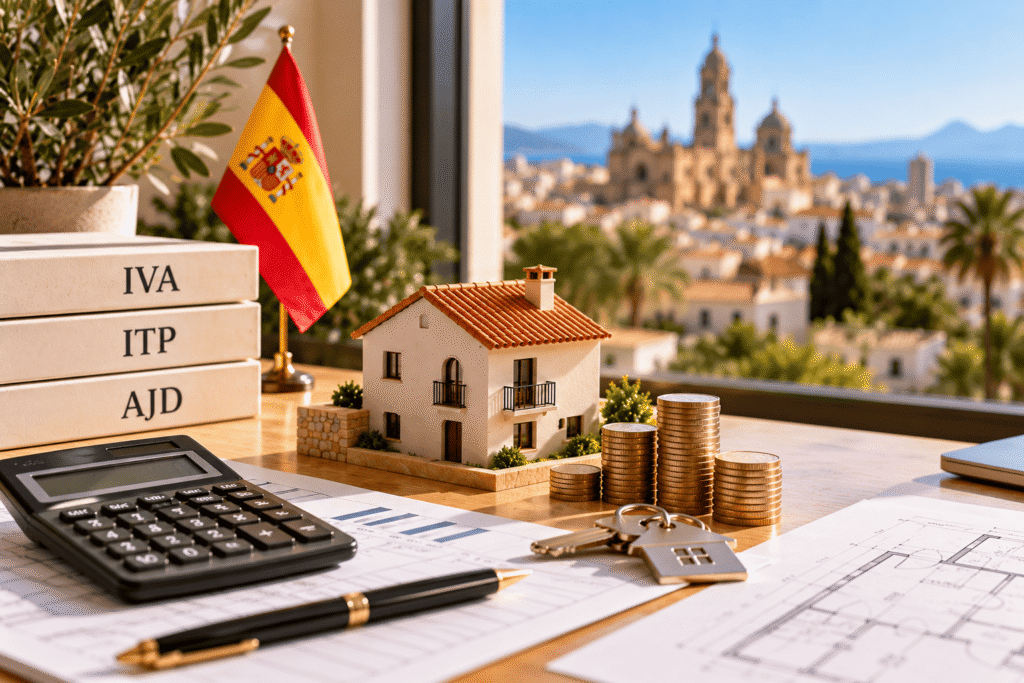
The amount of tax depends primarily on the type of property you are purchasing: a newly built property from a developer or a resale property. In the first case, VAT (IVA) is usually payable, while in the second, Property Transfer Tax (ITP) applies. In some situations, buyers may also be required to pay Stamp Duty (AJD).
In addition, tax rates may vary depending on the autonomous community where the property is located.
In this article, we will explain which taxes buyers pay when purchasing real estate in Spain, how the taxation of new-build and resale properties differs, and how to calculate additional expenses in advance.
What taxes do you pay when buying property in Spain?
When purchasing real estate in Spain, buyers may encounter three main taxes:
– IVA (Impuesto sobre el Valor Añadido) — Value Added Tax, which generally applies when purchasing a newly built property directly from a developer
– ITP (Impuesto sobre Transmisiones Patrimoniales) — Property Transfer Tax, which is generally payable when purchasing a resale property
– AJD (Actos Jurídicos Documentados) — Stamp Duty on documented legal acts, which may apply when formalizing a transaction
It is important to understand that IVA and ITP are generally not paid simultaneously in a standard residential property purchase. The applicable tax depends on the type of transaction.
AJD may be charged in addition to IVA when purchasing a new-build property. Its rate and the conditions under which it applies depend on the region and the circumstances of the transaction.
IVA when buying a new-build property in Spain
IVA is Value Added Tax. When purchasing a newly built property directly from a developer, it is generally included in the buyer’s expenses.
For most newly built residential properties, the standard IVA rate is 10% of the property’s value.
For example, if a newly built apartment costs €200,000, the calculation will be as follows:
– Apartment price — €200,000
– IVA at a rate of 10% — €20,000
– Total apartment price including IVA — €220,000
Therefore, the buyer needs to budget an additional €20,000 for IVA alone.
Special conditions and a reduced rate may apply to certain categories of social housing. In particular, a rate of 4% is available for specific types of protected housing.
Before purchasing, it is important to confirm which rate applies to the property you have chosen.
When is IVA paid?
IVA is generally paid when purchasing a newly built property directly from a developer.
This category typically includes properties being sold for the first time after construction has been completed.
However, not every apartment in a new building is automatically subject to IVA. If the property has already been transferred previously and is being used as a resale property, different tax rules may apply to the transaction.
Therefore, when choosing a property, it is necessary to clarify its legal status and the applicable tax treatment.
ITP when buying a resale property
ITP is Property Transfer Tax. It generally applies when purchasing a resale property from a private individual, provided that the transaction is not subject to IVA.
Unlike IVA, the ITP rate depends on the autonomous community where the property is located.
This means that buyers purchasing apartments in the Valencian Community, Catalonia, Andalusia, or Madrid may pay different amounts of tax even if the properties have the same purchase price.
How is ITP calculated?
To calculate ITP, you need to take into account:
– The property’s value
– The applicable tax rate in the autonomous community
– The taxable base, which, where required by law, may be determined using the cadastral value established for tax purposes — valor de referencia
– Any applicable tax reliefs and special conditions
For example, if the hypothetical ITP rate is 8% and the taxable base is €200,000, the calculation will be as follows:
– Taxable base — €200,000
– ITP at a rate of 8% — €16,000
This is an illustrative calculation, not a universal rate applicable throughout Spain.
Before purchasing, you should check the current rate and the rules for determining the taxable base in the specific region.
AJD when buying property in Spain
AJD is a tax on documented legal acts. It may apply to notarized documents that meet the requirements established by law.
When purchasing a new-build property, AJD is generally paid in addition to IVA.
The tax rate depends on the autonomous community where the property is located. Reduced rates or tax reliefs may apply in certain cases.
For a standard resale property purchase subject to ITP, AJD is generally not charged additionally on the same sale transaction in the same way as it is for a new-build purchase. However, certain documents or transactions related to the purchase may be subject to AJD.
If the buyer takes out a mortgage, the tax rules applicable to the mortgage agreement and the allocation of expenses between the parties must be considered separately.
How do taxes differ when buying a new-build property and a resale property?
The main difference lies in which tax applies to the transaction itself.
When purchasing a new-build property directly from a developer, the buyer generally pays IVA and, where applicable, AJD.
When purchasing a resale property, the buyer generally pays ITP. The amount is determined according to regional rules.
The main differences are as follows:
New-build property
– Main tax — IVA
– Standard IVA rate for most residential properties — 10%
– AJD may also apply
– The total tax amount depends on the property’s value and the regional AJD rate
Resale property
– Main tax — ITP
– The rate depends on the autonomous community
– The taxable base is determined according to the applicable rules
– Additional expenses depend on the transaction terms and the formalities involved
When comparing two properties with the same purchase price, it is important to consider not only the property price but also the total amount of taxes.
Example of calculating taxes on a property purchase worth €200,000
Let’s consider two hypothetical scenarios for purchasing a property worth €200,000.
Option 1 — purchasing a new-build property
Suppose the apartment is purchased directly from a developer and the standard IVA rate of 10% applies.
– Apartment price: €200,000
– IVA: €20,000
– Total amount including IVA: €220,000
An additional AJD payment may also be required. Its amount depends on the autonomous community and the specific terms of the transaction.
Option 2 — purchasing a resale property
Suppose the apartment costs €200,000 and the applicable ITP rate is 8%.
– ITP: €16,000
– Total amount including ITP: €216,000
This is a hypothetical example. In an actual transaction, the taxable base and the tax rate may differ.
Why is it important to consider the region?
Even if two apartments have the same purchase price, the total tax amount may differ significantly due to regional tax rates and calculation rules.
Therefore, before purchasing, you should check the tax conditions applicable specifically to the autonomous community where the property is located.
When and how are taxes paid when buying property?
Tax payment deadlines depend on the type of transaction and the applicable tax.
When purchasing a new-build property, IVA is generally paid to the developer as part of the payments under the contract. The payment procedure and schedule should be clarified before signing the documents.
ITP on a resale property is paid by the buyer within the legally established period after the transaction. The specific deadline depends on the applicable regional rules.
AJD must also be paid within the legally established deadlines if the relevant tax liability arises.
To complete the payments, it is generally necessary to prepare the transaction documents and submit the appropriate tax return or form.
Since deadlines and procedures may vary by region, it is advisable to confirm them with a specialist before completing the transaction.
What additional expenses should you consider besides taxes?
Taxes are not the only expense involved in purchasing real estate in Spain.
In addition to IVA, ITP, or AJD, buyers may need to budget for transaction formalities and legal assistance.
Additional expenses may include:
– Notary fees — preparation of the notarized deed of sale
– Property registration — recording the new owner’s details in the Property Registry
– Legal assistance — reviewing documents and transaction terms
– Banking expenses — if the buyer uses a mortgage or other banking services
– Document translation — if translations are required to complete the transaction
– Additional administrative expenses — depending on the circumstances of the purchase
Not all of these expenses are mandatory in every transaction. Their amount depends on the property’s value, the payment method, and the specifics of the transaction.
Therefore, it is best to calculate the purchase budget by taking all anticipated expenses into account, rather than considering only the property price and the main tax.
How to calculate your property purchase budget in Spain in advance
To avoid unexpected expenses, it is advisable to prepare a complete financial plan for the purchase in advance.
Step 1 — determine the type of property
Clarify whether you are purchasing a new-build property directly from a developer or a resale property.
This determines which tax generally applies to the transaction: IVA or ITP.
Step 2 — check the regional tax rate
Find out which tax rates apply in the autonomous community where the property is located.
Regional rules are particularly important for ITP and AJD.
Step 3 — clarify the taxable base
You need to check the amount on which the tax will be calculated.
In some cases, the taxable base may differ from the price stated in the contract.
Step 4 — calculate additional expenses
Add taxes, notary fees, registration costs, and any other expenses that may arise during the transaction to the property price.
Step 5 — set aside a financial reserve
Even with careful planning, it is useful to have a reserve for additional expenses that may arise during the process.
This approach allows you to estimate the total investment in advance and compare several properties.
What documents are required to pay taxes?
The following documents may be required to complete the purchase and pay the taxes:
– A document confirming the buyer’s identity
– NIE — Foreigner Identification Number, required for many legal and financial transactions in Spain
– The purchase and sale agreement or notarized deed
– Documents containing information about the property’s value
– Information about the property and its taxable base
– Proof of payment, if required
– Tax forms prescribed for the relevant tax
The exact list of documents depends on the type of transaction, the region, and the circumstances of the purchase.
An NIE is not a residence permit. It is an identification number used, among other things, when carrying out real estate transactions.
Common mistakes when calculating property taxes in Spain
When planning a purchase, foreign buyers sometimes focus only on the property’s price and overlook additional mandatory payments.
Here are some common mistakes.
Ignoring the difference between new-build and resale properties
IVA generally applies when purchasing a new-build property, while ITP generally applies to resale properties. Misidentifying the type of transaction can lead to an incorrect budget calculation.
Using a single tax rate for all of Spain
ITP and AJD rates may vary depending on the autonomous community.
Calculating the tax based only on the contract price
In some cases, the taxable base is determined according to special rules, including the valor de referencia.
Ignoring additional expenses
Notary fees, registration costs, and legal assistance increase the total cost of purchasing a property.
Failing to check current tax rules
Tax rates, reliefs, and calculation procedures may change. Therefore, it is necessary to check the current regulations before completing a transaction.
Conclusion — how much tax do you pay when buying property in Spain?
The amount of tax payable when purchasing real estate in Spain depends on the type of property, its value, the autonomous community, and the terms of the transaction.
When purchasing a new-build property directly from a developer, IVA at the standard rate of 10% generally applies. AJD may also be payable.
When purchasing a resale property, ITP generally applies, and its rate depends on the region.
In addition to taxes, buyers need to consider transaction formalities, notary fees, registration costs, and legal assistance.
To calculate the budget accurately, it is important to determine the type of property in advance, check the regional tax rates, and account for all additional payments.
Spanish Life helps you find property in Spain based on your budget, purchase goals, and preferred location. If you are considering buying an apartment, house, or investment property in Spain, submit a request — we will select current listings that match your criteria.
Important: Tax rates and taxation rules may change and vary depending on the autonomous community and the circumstances of the transaction. The calculations provided are illustrative examples and do not replace individual tax advice.

We will answer any question!


Online purchase
More details