What documents are required to purchase real estate in Spain?
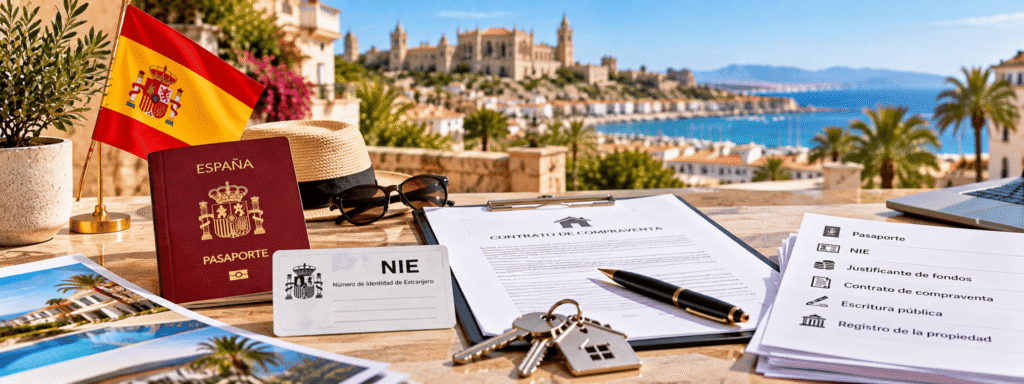
To purchase real estate in Spain, a foreign national must prepare several basic documents. Some are essential for completing the transaction, while others may be required depending on the payment method and the terms of the purchase.
1. Passport or another identity document
A passport is the primary document confirming the identity of a foreign buyer.
It is required for identification during the transaction, when dealing with the notary, and when preparing the necessary documents.
If several people are purchasing the property, each buyer must provide their own valid identity document.
The notary verifies the identity of the parties involved in the transaction and their right to enter into the agreement.
2. NIE — Foreigner Identification Number
NIE (Número de Identidad de Extranjero) is a foreigner’s identification number in Spain.
It is used for legal and financial transactions, including purchasing real estate, paying taxes, and registering ownership rights.
A NIE is required for a foreign buyer to complete the transaction. However, having a NIE does not automatically mean that a person has a residence permit in Spain.
If the buyer does not yet have a NIE, it should be obtained in advance or arranged during the preparation of the transaction.
The following documents are generally required to submit an application:
– Completed EX-15 form
– Valid passport and a copy
– Documents explaining the need to obtain a NIE
– Proof of payment of the required fee
The exact list of documents and the application procedure depend on the method of application.
3. Documents confirming the source of funds
When purchasing real estate in Spain, it is important to confirm the lawful origin of the money used for payment.
This is related to legal requirements aimed at preventing money laundering and the financing of terrorism.
The bank, notary, or other parties involved in the transaction may request documents confirming the source of funds.
Depending on the situation, these may include:
– Bank account statements
– Income and salary certificates
– Tax returns
– Documents relating to the sale of another property
– Inheritance documents
– Documents relating to dividends or income from business activities
– Documents confirming receipt of funds as a gift, where applicable
The required documents depend on the specific circumstances. It is advisable to prepare documents in advance that explain the origin of the entire amount intended for the purchase.
4. Proof of residential address
In some cases, the bank or other parties involved in the transaction may request proof of the buyer’s residential address.
The following documents may be used:
– Utility bill
– Bank statement showing the address
– Proof of registration at the place of residence
– Another official document confirming the address
Whether this document is required depends on the requirements of the relevant institution and the circumstances of the transaction.
5. Banking documents
If the buyer is paying for the property with personal funds, they should agree on the transfer method in advance and prepare documents confirming the payments.
If a mortgage is used, the list of required documents will be considerably longer.
The bank may request information about income, employment, financial obligations, and existing savings.
If the buyer is not a resident of Spain, the requirements for confirming income may differ from those applicable to residents.
Opening a bank account in Spain is not a universal requirement for every purchase. However, such an account can simplify payments, cover expenses, and manage the property after the purchase.
What documents does a non-resident need to buy property in Spain
A foreign national can purchase real estate in Spain even if they do not live in the country permanently.
The basic list of documents for a non-resident generally includes:
– Valid passport
– NIE
– Documents confirming the source of funds
– Documents required to prepare the purchase agreement
– Proof of payment for the property
– Additional documents if requested by the bank or notary
If the buyer is applying for a mortgage, a separate set of financial documents will be required.
Foreign-issued documents may need an apostille or another form of legalisation, as well as an official translation into Spanish. This depends on the type of document and the requirements for its use in Spain.
What documents should be checked with the seller
Before purchasing a property, it is important to check not only your own documents but also the documents relating to the property.
This helps ensure that the seller has the legal right to dispose of the property and that the property is not subject to obligations unknown to the buyer.
1. Extract from the Property Registry — Nota Simple
Nota Simple is an informational extract from Spain’s Property Registry (Registro de la Propiedad).
It can be used to check:
– Who is registered as the owner of the property
– The main characteristics of the property
– Registered rights and restrictions
– The existence of registered mortgages and other encumbrances
Nota Simple helps identify legal circumstances that may affect the purchase.
However, it is informational in nature and does not replace an official registry certificate.
2. Document confirming the seller’s ownership rights
It is necessary to ensure that the seller actually has the right to sell the property.
For this purpose, the information in the Property Registry and the documents under which the seller acquired the property are checked.
If the property belongs to several owners, it is important to determine who must participate in the transaction and sign the agreement.
If the seller is acting through a representative, the existence and contents of the power of attorney must be checked.
3. Cadastral information — Referencia Catastral
Referencia Catastral is a unique cadastral identifier for a property.
It helps identify the property in the Spanish Cadastre and compare its details with other documents.
Cadastral information may include details about the location, area, use, and other characteristics of the property.
During the verification process, it is important to compare the cadastral data with the information in the Property Registry and the actual condition of the property.
4. Certificate confirming no outstanding debts to the owners’ association
If the apartment is located in a multi-unit building or residential complex with an owners’ association, it is necessary to check whether there are any outstanding common charges.
For this purpose, a relevant certificate confirming the payment status with the comunidad de propietarios is requested.
This check helps determine whether there are unpaid contributions for the maintenance of common areas and infrastructure.
5. Documents confirming payment of taxes and utility bills
Before purchasing, it is advisable to check whether property taxes and basic utility bills have been paid.
In particular, it is worth verifying the payment status of IBI — the annual municipal property tax.
It is also important to find out whether there are any outstanding bills for water, electricity, or other services associated with the property.
The exact list of documents depends on the property and the terms of the transaction.
What documents are needed to sign a purchase agreement
After the property has been checked and the terms of the transaction have been agreed upon, the parties prepare to sign the agreement.
Depending on the stage of the purchase, the following documents may be used.
Reservation agreement — Contrato de Reserva
Contrato de Reserva is an agreement that may be used to temporarily reserve the selected property for the buyer.
It usually includes:
– Details of the buyer and seller
– Information about the property
– The property price
– The reservation fee amount
– The reservation period
– Conditions for refunding or retaining the fee
The terms of such an agreement should be carefully reviewed before making a payment.
Preliminary agreement — Contrato de Arras
Contrato de Arras is a preliminary agreement that usually sets out the arrangements between the buyer and the seller.
It may include:
– The property price
– The deposit amount
– The deadline for signing the main agreement
– The obligations of the parties
– Conditions for withdrawing from the transaction
– Consequences of failing to comply with the agreed terms
The conditions for refunding the deposit depend on the type of agreement and its contents.
Before signing, it is important to review all the provisions of the document and ensure that they correspond to the parties’ agreements.
Notarial purchase agreement — Escritura Pública de Compraventa
Escritura Pública de Compraventa is a notarial document formalising the property purchase and sale transaction.
When signing, the notary verifies the identity of the parties, the authority of representatives, and the required documents. The notary also records the terms of the transaction and payment details.
The notarial deed is the main document required for the subsequent registration of the acquired ownership rights in the Property Registry.
Although Spanish law recognises transactions that may be valid without a notarial deed, notarial formalisation is important for property registration and the legal protection of the parties.
What documents are needed when purchasing property with a mortgage
If the buyer plans to use a mortgage, they must prepare additional documents for the bank.
The exact list depends on the financial institution, citizenship, residency status, and sources of income.
The bank may request:
– Passport and NIE
– Documents relating to the place of residence
– Salary certificates
– Employment contract or proof of employment
– Tax returns
– Bank account statements
– Information about existing loans and financial obligations
– Documents confirming the availability of a down payment
– Information about the property being purchased
Entrepreneurs and business owners may be required to provide documents relating to the company’s activities, income, and tax obligations.
Non-residents may sometimes need to provide documents from their country of residence. Depending on the bank’s requirements, these may need to be translated and legalised.
It is advisable to check the bank’s requirements in advance, as mortgage approval and document preparation may take additional time.
Can you buy property in Spain remotely
Yes, in certain cases, a property purchase can be completed without the buyer being physically present in Spain.
A power of attorney may be used for this purpose, allowing a representative to act on the buyer’s behalf.
A power of attorney can be prepared by a Spanish notary or through the relevant consular institution. If the document is issued outside Spain, legalisation or an apostille and a translation may be required.
The power of attorney must clearly specify the representative’s authority, such as the right to sign the purchase agreement, make the necessary payments, or prepare documents for property registration.
The exact procedure depends on the contents of the power of attorney and the requirements of the notary handling the transaction.
How does the property purchase process work in Spain
The purchase process can be divided into several stages.
Step 1 — Choosing a property
The buyer determines the budget, purchase objectives, and selects a suitable property.
Step 2 — Preparing the buyer’s documents
The buyer must prepare a passport, NIE, and any documents that may be required to confirm the source of funds.
Step 3 — Legal verification of the property
The Property Registry records, the seller’s ownership rights, encumbrances, and other legal circumstances are checked.
Step 4 — Agreeing on the terms of the transaction
The parties determine the property price, payment deadlines, and conditions for signing the agreement.
Step 5 — Signing the preliminary agreement
If the parties use a reservation agreement or Contrato de Arras, its terms must be checked before making a payment.
Step 6 — Preparing for notarial formalisation
The buyer and seller provide the documents required to complete the transaction. If a mortgage is used, the terms of bank financing are also agreed upon.
Step 7 — Signing the notarial deed
The parties sign the Escritura Pública de Compraventa and make the payments in accordance with the terms of the transaction.
Step 8 — Paying taxes and registering the property
After the transaction is completed, the tax obligations must be fulfilled and the ownership rights registered in the Property Registry.
Common mistakes when preparing documents
When purchasing property in Spain, foreign buyers may encounter several common problems.
Failing to obtain a NIE in advance
Not having a NIE may complicate document preparation and the completion of the transaction. It is advisable to allow sufficient time to obtain one.
Failing to prepare documents confirming the source of funds
If the bank or notary requests proof of the source of funds, the absence of the required documents may delay the transaction.
Failing to check the property documents
Before signing the agreement, it is important to ensure that the seller has the right to dispose of the property and that the information about it is accurate.
Signing an agreement without checking its terms
Before paying a deposit, it is necessary to carefully review the deadlines, obligations of the parties, and consequences of withdrawing from the transaction.
Failing to check the requirements for document translation
Documents issued outside Spain may require an apostille, legalisation, or an official translation.
Failing to account for additional bank requirements
When purchasing with a mortgage, it is important to clarify the list of financial documents and submission deadlines in advance.
Checklist of documents required to purchase property in Spain
Before completing the transaction, check whether the following documents have been prepared.
Buyer’s documents
– Passport or another valid identity document
– NIE
– Documents confirming the source of funds
– Proof of residential address, if required
– Banking documents necessary for payments
Property documents
– Nota Simple
– Documents confirming the seller’s ownership rights
– Cadastral information
– Certificate confirming no outstanding debts to the owners’ association, where applicable
– Documents confirming payment of taxes and utility bills, if required
Documents required to complete the transaction
– Reservation agreement, if used
– Contrato de Arras, if concluded
– Notarial purchase and sale deed
– Proof of payment
– Power of attorney, if the buyer is acting through a representative
– Documents required for paying taxes and registering the property
This list is indicative. The specific requirements depend on the property, the terms of the purchase, and the buyer’s status.
Summary — what documents are needed to buy property in Spain
To purchase property in Spain, a foreign national generally needs a passport, NIE, documents confirming the source of funds, and documents related to the transaction.
It is also important to check the legal status of the property, the seller’s ownership rights, and any potential encumbrances.
If the purchase is financed with a mortgage or completed remotely, additional documents and a power of attorney may be required.
Preparing the documents in advance helps avoid delays, organise payments correctly, and complete all stages of the transaction with a clear understanding of the obligations involved.
Spanish Life helps you find property in Spain based on your budget, purchase objectives, and preferred location. If you are considering buying an apartment, house, or investment property in Spain, submit a request and we will select current listings that match your requirements.
Important: The list of required documents depends on the circumstances of the transaction, the requirements of the notary and bank, and the applicable legislation. Before signing the agreement, it is advisable to have the documents and terms of the specific purchase reviewed by a specialist.


We will answer any question!


Online purchase
More details